




Our Range
See All
Specification
Door Hardware
Designer Hardware

Fire Doors and Architectural Ironmongery: Why the Hardware Specification Cannot Be Considered in Isolation
Fire doors are frequently discussed in terms of door leaves, frames, seals and fire-resistance periods. For architects and architectural ironmongers, however, there is another important part of the specification: the hardware attached to the door.
Handles, locks, latches, hinges, closers and associated components are not simply decorative additions to a fire-resisting door assembly. Their selection and installation can affect how the door operates in everyday use and how the complete assembly performs when required.
That makes fire-door ironmongery a coordination exercise rather than a shopping list.
Think about the doorset, not just the handle
One of the most useful principles when specifying hardware for a fire door is to stop thinking of individual products in isolation.
A fire-resisting door relies upon a combination of components working together. The door leaf, frame, glazing where present, seals, hinges, closer, latch or lock and other hardware all form part of the finished assembly.
A technically impressive piece of hardware does not automatically make it appropriate for every fire door.
The relevant evidence for the proposed doorset and application should therefore guide product selection.
This becomes particularly important when products are substituted during procurement. A fitting that appears visually or mechanically similar to the item originally specified should not automatically be assumed to provide equivalent suitability.
Fire doors also have to work every day
A fire door has an essential safety function, but for almost all of its working life it is simply a door.
People may operate it hundreds of times each day.
That creates an interesting specification challenge. Hardware needs to support the required fire performance while also responding to durability, accessibility, security, maintenance and the architectural character of the building.
For an architectural ironmonger, these requirements need to be considered together.
A heavily used hospital corridor, for example, presents a different operational environment from an office store cupboard even if both locations require fire-resisting doors.
The specification should reflect that difference.
Self-closing performance deserves particular attention
Government guidance under the Fire Safety (England) Regulations highlights the importance of checking that fire doors close correctly and that door closers successfully shut the door. It also identifies seals, hinges, damage and gaps around the frame among the items that should be examined. Welcome to GOV.UK
This is a useful reminder that selecting door furniture cannot be separated from the behaviour of the complete door.
A closer that makes a door unnecessarily difficult to operate can create accessibility problems. A door that does not reliably return to its frame creates a different and potentially much more serious problem.
Successful specification requires those requirements to be reconciled.
Accessibility still applies
Fire safety and inclusive design should not be treated as competing disciplines.
A door may need to provide fire separation while remaining practical for people with reduced strength, mobility or dexterity.
For architects, this means considering the interaction between the handle, lock or latch, door closer, door dimensions and the force required to operate the door.
A well-designed lever can help with usability, but the handle alone cannot compensate for an unsuitable complete doorset.
This is another reason for coordinating hardware early rather than leaving ironmongery until the architectural design is substantially complete.
Be particularly cautious with substitutions
Late substitutions are common on construction projects.
Sometimes they are perfectly reasonable. Products become unavailable, lead times change or an alternative provides an equivalent solution.
Fire doors, however, are an area where equivalence should be demonstrated rather than assumed.
Changing a hinge, lock, latch, closer or other component can introduce questions about the evidence supporting the complete assembly.
The right question is therefore not:
“Will this alternative fit?”
It is:
“Is this alternative appropriate for this particular fire-resisting door assembly, and what evidence supports its use?”
That small change in language encourages a much more rigorous specification process.
Standards and guidance continue to evolve
Fire-safety specification is also an area in which architects and ironmongers need to work from current information.
Approved Document B https://www.gov.uk/government/publications/fire-safety-approved-document-b provides statutory guidance supporting the fire-safety requirements of the Building Regulations in England. The government has already published amendments scheduled to take effect on 30 September 2026, while further changes are scheduled for 2029 Welcome to GOV.UK
The Building Safety Regulator has also placed Approved Document B under continuous review and consulted during 2026 on further proposed changes to the guidance. GOV.UK
For specifiers, the practical lesson is straightforward: specifications copied from an older project should not automatically be assumed to represent current requirements.
The applicable regulations, guidance, standards and product evidence should be checked for the project being designed.
Maintenance should influence specification
Good ironmongery specification also considers what happens after handover.
Hardware is exposed to wear, impact, adjustment and sometimes misuse throughout the life of a building.
Government fire-door guidance makes clear that ongoing inspection is important. For relevant residential buildings, the Fire Safety (England) Regulations 2022 introduced specific requirements concerning checks of fire doors, while broader duties under fire-safety legislation require responsible persons to maintain appropriate fire precautions.
For architects and clients, this creates a strong argument for selecting robust, maintainable hardware in the first place.
The cheapest compliant solution on installation day is not necessarily the most economical solution over the working life of the building.
Interior design still matters
Fire performance does not mean every door has to look overtly technical.
Door furniture remains one of the most frequently seen and touched elements of an interior.
The challenge for designers is to select hardware that satisfies the technical requirements of the doorset while maintaining consistency across the wider interior.
This becomes particularly noticeable where fire doors sit alongside non-fire-resisting doors within the same visual environment.
A coordinated family of handles and finishes can allow the specification to respond to different technical requirements without creating an unnecessarily fragmented interior.
Specialist environments add another layer
Healthcare and mental-health environments can make the specification considerably more complex.
The same door may need to address fire safety, accessibility, heavy usage and, depending upon the location and risk assessment, specialist considerations such as ligature reduction.
These requirements should not be resolved independently.
A product selected because of one desirable characteristic still needs to be appropriate for the complete application.
Early collaboration between the architect, architectural ironmonger, doorset supplier, fire specialist where required and hardware manufacturer can therefore prevent conflicts emerging much later in the project.
Manufacturing knowledge has a role
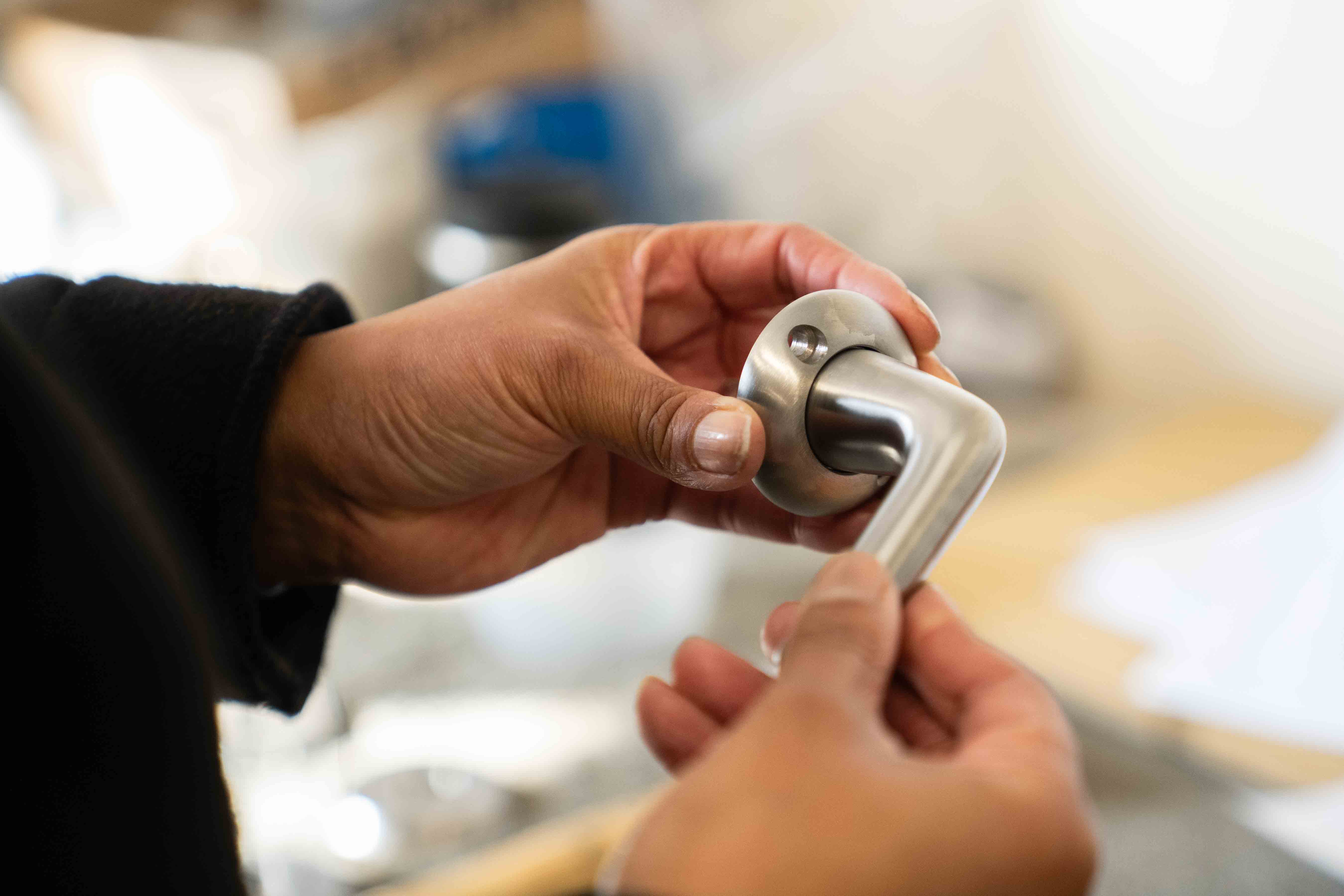
This is one area where direct access to the people making the hardware can be valuable.
Dortrend International has manufactured architectural and specialist door hardware for more than 50 years. Founded in 1972, the company now manufactures more than 85% of its products at its Worcester factory and combines in-house manufacturing with product development and bespoke capabilities. Premium Door Handles & Anti Ligature Hardware | Dortrend
For specifiers, the value of that manufacturing capability is not simply the "Made in Britain" label.
It provides an opportunity to discuss materials, dimensions, fixings, finishes, specialist requirements and manufacturing constraints directly with a company involved in producing the component.
On complicated doorsets, that conversation can be much more useful than choosing hardware solely from an image or catalogue description.
Five questions worth asking before signing off the hardware schedule
Before finalising ironmongery for a fire-resisting door, the project team should be able to answer five basic questions:
Is the proposed hardware appropriate for the particular doorset and application?
What evidence supports its use?
Will the complete door remain practical and accessible for its intended users?
Is the hardware sufficiently durable for the anticipated frequency of operation?
Have installation, inspection, adjustment and future maintenance been considered?
If those questions cannot be answered confidently, the specification probably needs another conversation.
A small component of a much bigger system
Architectural ironmongery represents only one part of a fire door, but that is precisely why it needs careful coordination.
The handle cannot be considered independently from the latch. The latch cannot be considered independently from the door. And the door cannot be considered independently from the building's wider fire strategy.
For architects, ironmongers and interior designers, good specification therefore comes from balancing performance, usability, durability and design while respecting the evidence applicable to the complete doorset.
A fire door is a system. Its hardware should always be specified as though it is part of one.